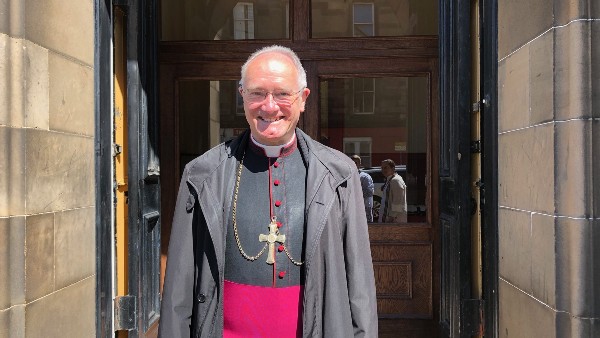
Where does SSPX stand with Rome
On November 1, 2012, on the feast of All Saints, Bishop Bernard Fellay celebrated Mass at the seminary in Ecône. During his sermon, after recalling the spiritual meaning of this feast, he explained the status of the relations of the Society of Saint Pius X with Rome. – The title and subtitles are by the editors of DICI.
some excerpts - for the full sermon go to the dici website.
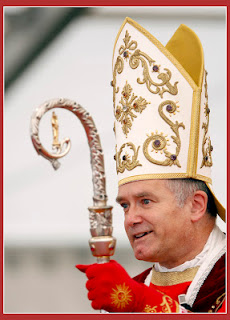 …Now, to speak about the future, what we will try to do with the Roman authorities is to tell them that it does no good to pretend,
for the sake of the faith, that the Church cannot be mistaken. Because, at the level of faith, we are entirely in agreement about the assistance
of the Holy Ghost, but you have to open your eyes to what is happening in the Church! It is necessary to stop saying:
the Church can do nothing bad, therefore the new Mass is good. It is necessary to stop saying:
the Church cannot err, and therefore there is no error in the Council. But look at reality then!
There can be no contradiction between the reality that we apprehend and the faith. It is the same good God who made both.
Therefore if there is an apparent contradiction, there is certainly a solution. Perhaps we don’t have it yet, but
we are not going to deny reality for the sake of the faith! Now this is truly the impression that one has with regard
to what Rome is trying to impose on us today. And here we reply: we cannot. That is all.
…Now, to speak about the future, what we will try to do with the Roman authorities is to tell them that it does no good to pretend,
for the sake of the faith, that the Church cannot be mistaken. Because, at the level of faith, we are entirely in agreement about the assistance
of the Holy Ghost, but you have to open your eyes to what is happening in the Church! It is necessary to stop saying:
the Church can do nothing bad, therefore the new Mass is good. It is necessary to stop saying:
the Church cannot err, and therefore there is no error in the Council. But look at reality then!
There can be no contradiction between the reality that we apprehend and the faith. It is the same good God who made both.
Therefore if there is an apparent contradiction, there is certainly a solution. Perhaps we don’t have it yet, but
we are not going to deny reality for the sake of the faith! Now this is truly the impression that one has with regard
to what Rome is trying to impose on us today. And here we reply: we cannot. That is all.
And therefore we continue, come what may! We know very well that one day this trial—a trial that affects the whole Church—will end, but we do not know how. We try to do everything that we can. Don’t be afraid. The good Lord is above all that; He is still the boss. That is the extraordinary thing. And the Church, even in this state, is still holy, is still capable of sanctifying. If today, my very dear brothers, we receive the sacraments, grace, the faith, it is through this Roman Catholic Church, not through her faults but certainly through this real, concrete Church. It is not an image, it is not an idea, it is a reality, the most beautiful aspect of which we are celebrating today: Heaven. Well! Heaven is prepared here below. That is the beauty of the Church, this terrifying, extraordinary combat with the forces of evil in which the Church finds herself, and even in this state of terrible suffering in which she is today, she is still capable of transmitting the faith, of transmitting grace, the sacraments. And if we give them—these sacraments and this faith—it is through this Church, it is in the name of this Church, it is as instruments and members of the Catholic Church that we do so.
 May the saints in Heaven, may the angels come to our aid and support us! Obviously it is not easy, obviously we are fearful.
This is what today’s Gradual says. It is necessary to have fear of God. To those who fear Him, the good Lord gives everything.
Let us not be afraid of having fear of the Lord. The fear of the Lord is the beginning of wisdom. May it lead us through the
labyrinths of life here below toward Heaven, where the Blessed Virgin Mary, Queen of all saints, Queen of angels, is really
our protectress, truly our Mother. If we say about Our Lord that He wants to be all in all, we must say almost the same thing
about the Blessed Virgin. We have a mother in Heaven who has received from God an extraordinary power, the power to crush Satan’s
head, to crush all heresies. Therefore we can also say that she is the mother of faith, the mother of grace. Let us go to her.
Let us consecrate to her our lives, our families, our joys, our sufferings, our plans, our desires. May she lead us to that eternal
haven so that we might always enjoy eternal happiness with all the saints, that vision of God which is the beatific vision. So be it. Amen.
May the saints in Heaven, may the angels come to our aid and support us! Obviously it is not easy, obviously we are fearful.
This is what today’s Gradual says. It is necessary to have fear of God. To those who fear Him, the good Lord gives everything.
Let us not be afraid of having fear of the Lord. The fear of the Lord is the beginning of wisdom. May it lead us through the
labyrinths of life here below toward Heaven, where the Blessed Virgin Mary, Queen of all saints, Queen of angels, is really
our protectress, truly our Mother. If we say about Our Lord that He wants to be all in all, we must say almost the same thing
about the Blessed Virgin. We have a mother in Heaven who has received from God an extraordinary power, the power to crush Satan’s
head, to crush all heresies. Therefore we can also say that she is the mother of faith, the mother of grace. Let us go to her.
Let us consecrate to her our lives, our families, our joys, our sufferings, our plans, our desires. May she lead us to that eternal
haven so that we might always enjoy eternal happiness with all the saints, that vision of God which is the beatific vision. So be it. Amen.
In order to preserve the character of this sermon, the oral style has been retained.
(Source: FSSPX/MG – Pictures : Seminary of Ecône – Transcription and translation by DICI no. 264 dated November 9, 2012)
http://www.dici.org/en/
Extracts from Spiegel on line 1st February 2010
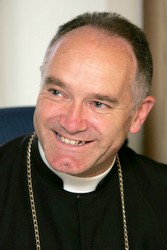 "We have lost one of our four bishops" says Bishop Fellay
"We can't use him for anything anymore."
He had hoped and believed that Bishop Williamson had understood things better in the meantime (since Jan 2009)
but unfortunately Bishop Williamson has not understood.
"We have lost one of our four bishops" says Bishop Fellay
"We can't use him for anything anymore."
He had hoped and believed that Bishop Williamson had understood things better in the meantime (since Jan 2009)
but unfortunately Bishop Williamson has not understood.
Bishop Fellay likens Bp Williamson to uranium, "it's dangerous when you have it but you simply can't leave it by the side of the road".
Bishop Fellay speaks about the internet. Extracted from an interview 2009.
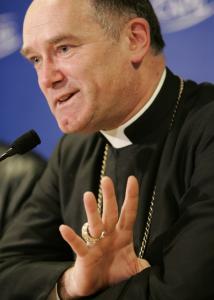 I do not see so much of a difference between the Internet,
television, radio, the press, and the media in general. We can basically
say, for all of these things, that the children of the world are wiser
than the children of God. Taken by itself, the Internet is a means, and
the right use of a means will bring good fruits; the wrong use will
bring bad fruits. Now, it's not simply a means; it's a very powerful
means because you can reach the whole world. It's very impressive, but
this ability is something which has never happened before in history.
The radio was seen as a novelty because it was able to reach millions of
ears; the television was more since it could capture eyes; the Internet
makes it possible for anybody at a very low cost.
I do not see so much of a difference between the Internet,
television, radio, the press, and the media in general. We can basically
say, for all of these things, that the children of the world are wiser
than the children of God. Taken by itself, the Internet is a means, and
the right use of a means will bring good fruits; the wrong use will
bring bad fruits. Now, it's not simply a means; it's a very powerful
means because you can reach the whole world. It's very impressive, but
this ability is something which has never happened before in history.
The radio was seen as a novelty because it was able to reach millions of
ears; the television was more since it could capture eyes; the Internet
makes it possible for anybody at a very low cost.
There is no comparison then between the Internet and these other things. That means whoever wants to say something whatever it is he may do it. This is one of the truly major problems of the Internet and of Tradition. You have people who have an idea of Tradition maybe correct, maybe incorrect and who simply talk. Whoever has access to what is said does not necessarily know what is right or true. This is a very serious and grave problem. When you talk about preaching the truth, the Church has this mission. The Society, as part of the Church, participates in this duty to spread the truths of Revelation. But now everyone can pretend to have authority with great ease. Of course, they have no authority, but everybody imposes themselves as Doctors of the Faith today. There is usually no way to check the quality of the one who speaks. It is a very embarrassing problem. We have experienced, for years, a major problem there. We have people who, for example, attack us unjustly with calumnies, and there is almost no way for us to stop them. Thus, whoever wants to listen to them may do so. By doing so, they may endanger their trust in the Society. I would go so far as to say that, by putting this relationship with the Society in danger, they easily fall into mortal sin.
When you see the trash, hatred, and calumnies spread on some sites , you realize they are dangerous places. And you have no right to expose yourself to dangerous places. The Internet is quite a challenge. On the one hand, it is now a common means of communication, even the normal method today. So we are obliged to use it. We may not simply ignore it. There is a great need to educate people in how to correctly use this means.
Press Release from the Superior General of the Priestly Society of Saint Pius X on Motu Proprio
The excommunication of the bishops consecrated by His Grace Archbishop Marcel Lefebvre, on June 30, 1988, which had been declared by the Congregation for Bishops in a decree dated July 1, 1988, and which we had always contested, has been withdrawn by another decree mandated by Benedict XVI and issued by the same Congregation on January 21, 2009.
We express our filial gratitude to the Holy Father for this gesture which, beyond the Priestly Society of Saint Pius X, will benefit the whole Church. Our Society wishes to be always more able to help the pope to remedy the unprecedented crisis which presently shakes the Catholic world, and which Pope John Paul II had designated as a state of "silent apostasy."
Besides our gratitude towards the Holy Father and towards all those who helped him to make this courageous act, we are pleased that the decree of January 21 considers as "necessary" talks with the Holy See, talks which will enable the Priestly Society of Saint Pius X to explain the fundamental doctrinal reasons which it believes to be at the origin of the present difficulties of the Church.
In this new atmosphere, we have the firm hope to obtain soon the recognition of the rights of Catholic Tradition.
+Bernard Fellay Menzingen, January 24, 2009
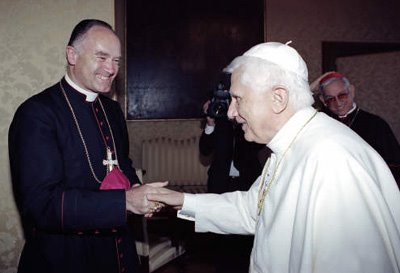
Bishop Bernard Fellay, head of the Society of Saint Pius X, has told SPIEGEL that his organization has "clearly distanced itself" from Bishop Richard Williamson. Nevertheless, he says the bishop's apology for his Holocaust denial is a step in the right direction.
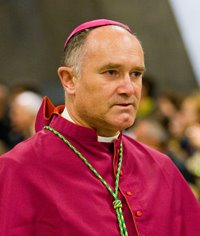 SPIEGEL: Bishop, weeks ago you gave your colleague
Richard Williamson a book so that he can read up on the Holocaust. Last
week he published an apology which falls short of the Vatican's demand
that he retract his Holocaust denial. Does Williamson's statement
suffice in your opinion?
SPIEGEL: Bishop, weeks ago you gave your colleague
Richard Williamson a book so that he can read up on the Holocaust. Last
week he published an apology which falls short of the Vatican's demand
that he retract his Holocaust denial. Does Williamson's statement
suffice in your opinion?
Fellay: It is definitely a first plea for forgiveness and, therefore, an important step in the right direction. One can always hope for better phrasing. At least the plea for forgiveness is honest, and the withdrawal of his words is genuine.
SPIEGEL: That hope seems unfounded. After his arrival in London, Williamson surrounded himself with people who have openly denied the Holocaust, such as the historian David Irving. Do you know why?
FROM THE MAGAZINE
Fellay: I have the impression that Bishop Williamson is being used by these people. Information was deliberately fed to the media here. We're working against that as well as we can. I am totally against these connections.
SPIEGEL: But your influence on Williamson seems to be weak.
Fellay: We are in contact, he is in a priory of the society in London for the time being. But he is also a free human being. Sure, he has a superior, but he is free in his decisions. But he has to bear the consequences for that.
SPIEGEL: Will he return to his full duties?
Fellay: That is impossible under the current circumstances. He has damaged us and hurt our reputation. We have very clearly distanced ourselves. He was not ordained as a bishop for his own personal purpose but for the common good of the church, to spread the revealed truth.
SPIEGEL: So why don't you exclude Williamson from the society?
Fellay: That will happen if he denies the Holocaust again. It is probably better for everyone if he stays quiet and stays in a corner somewhere. I want him to disappear from the public eye for a good while.
SPIEGEL: The Vatican could reinstate the excommunication because he has not made a retraction.
Fellay: I doubt that. Denial of the Holocaust, as serious as it is, isn't part of Canon Law -- so an excommunication isn't possible. It isn't just we who say that, it is canons, legal experts. The problem is that his comments have been linked to his office.
SPIEGEL: Regensburg's Bishop Gerhard Ludwig M"ller has denied the German Pius seminary in Zaitzkofen permission to ordain more priests. Will you adhere to the ban?
Fellay: That was unnecessary and inappropriate. All these events definitely are a setback for us. It throws us back by 10 years. But ordinations will continue to happen.
SPIEGEL: In Germany politicians fear that schools run by the society don't share the values of the German constitution. Are you concerned that there will be inspections?
Fellay: I'm not worried about that at all. We are normal people. We observe the rules, and that includes the state order. Even if one voice said something wrong. It is expressly written in the epistles of the Saint Paul that we honor authority and pray for it.
SPIEGEL: So Williamson is someone who has gone astray and criticism of the society is a big misunderstanding?
Fellay: Now we're the world's scapegoat, and every wrong step immediately turns into a scandal. But mistakes that need to be corrected are made all the time and everywhere.
SPIEGEL: Why did you respond so late to Williamson's crude theses?
Fellay: I confess that I didn't take the situation seriously enough.
Interview conducted by Stefan Winter. 2nd March 2009.